
Delight in the Age of AI
Way back in 2014, at the start of my design career, I was contemplating delight in product design. The concept was quite trendy then, much like "craft" and "taste" are now.
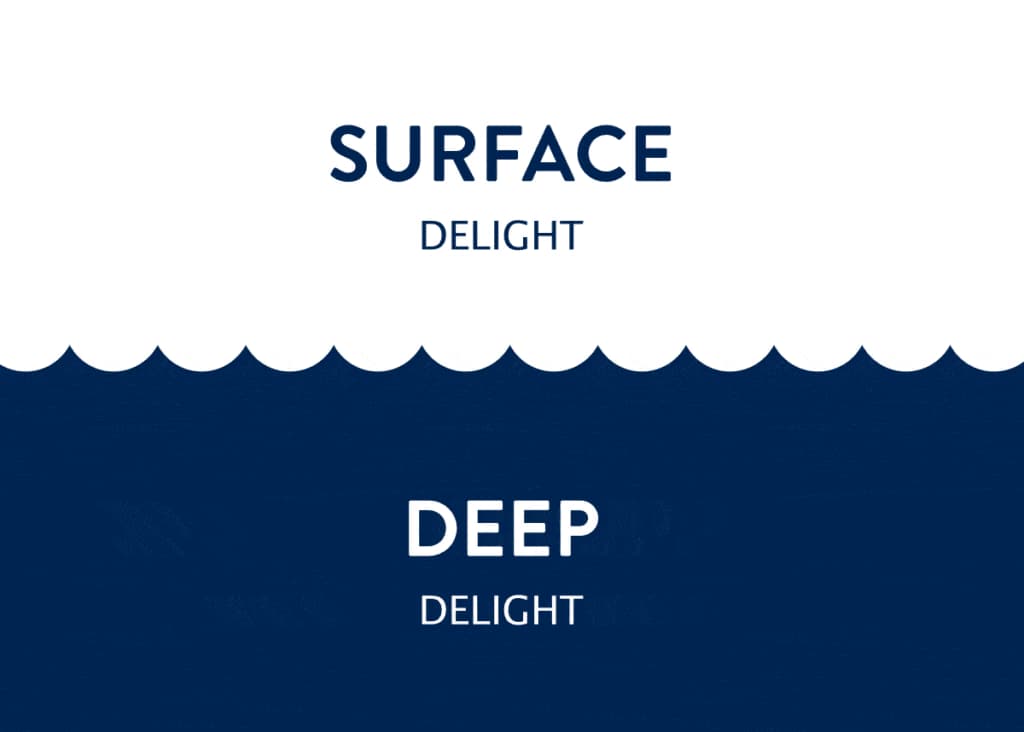
My colleague Ben Tollady presented on this topic at UX Australia. Our fundamental premise was straightforward: delight comes in two varieties:
- Surface delight — animations, microcopy, visual craft; moments that create pleasurable sensations
- Deep delight — emerges from truly grasping a problem, eliminating obstacles, and enabling users to achieve flow; operates invisibly when functioning properly
Now in 2026, this distinction feels particularly pertinent — perhaps even more so — given AI's emergence.
Craft, Taste, Polish, Surface Delight
Much discussion about designer relevance in an AI era emphasizes craft and taste. "AI generates competent interfaces instantly, but human-created texture becomes the differentiator." This represents surface delight's resurgence.
I find this exciting. Embracing rapid prototyping enables showcasing newfound abilities in crafting appealing surfaces. AI actually frees designers to prioritize surface craft further, not restrict it. Budget and timeline constraints historically limited this work. Faster structural development permits obsessing over microinteractions and transitions. Tools like Claude Code and Cursor provide these capabilities.
Studios like NotBoring demonstrate this — custom animations, haptics, sound design showcase remarkable attention to detail. When competence is commoditised, delight is what's left.
Delight Goes Deeper
But here's what remains largely unaddressed: deep delight.
Deep delight isn't about polish. It requires understanding — investing time with problems until revealing what's genuinely occurring. It means research uncovering surprising insights. It involves designing flows so intuitively users forget they're navigating software.
The challenge: you can't vibe-code your way to deep delight.
Deep delight demands process — not performative frameworks, but disciplined thinking confirming you're addressing the correct problem. Experienced designers internalize this so thoroughly it resembles intuition.
Skipping process enables rapid surface improvement while expanding deep delight gaps. Without structure, speed moves you swiftly in potentially wrong directions.
AI compresses idea-to-reality timelines dramatically. Yet it cannot determine whether your initial concept was sound. That still requires unglamorous work: understanding individuals, their challenges, and their circumstances.
Design Needs Both
AI compresses the middle — the functional, usable layer historically consuming most effort. Both extremes remain human territory. Surface delight requires craft. Deep delight requires understanding.
Succeeding designers won't be fastest. They'll operate competently across both ends — obsessing over button feel and questioning whether buttons should exist.