
Designing an AI Copilot for Customer Support
I led design on Block's AI copilot for customer support — reframing it from a chatbot into a proactive assistant that earned trust in a high-stakes environment.
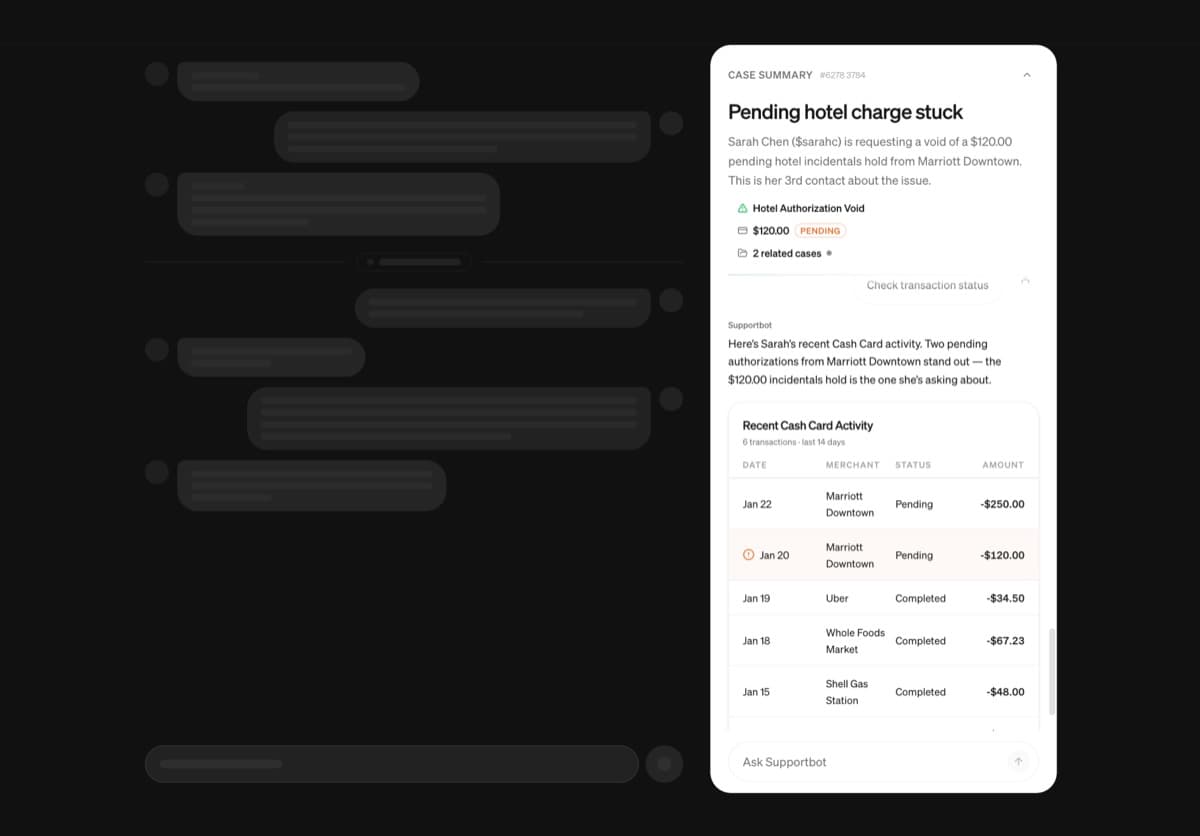
The problem
Block was shifting toward AI-first support, but the early product direction leaned on a chatbot-style interface — ask the AI a question, get an answer. On the surface, it made sense. But support work is high-stakes. Advocates are measured on speed and accuracy, and many are based in regions where English isn't a first language. A purely conversational interface risked adding friction at exactly the moments where decisiveness matters.
The reframe
Instead of asking how advocates could talk to AI, I focused on how AI could support advocates inside their existing workflows. That shift changed the trajectory of the product. Conversation became one capability, not the entire interaction model — expanding from reactive chat to proactive assistance.
The solution
We shipped a focused core release — Q&A chat, case summaries, an actions menu, suggestion pills, and contextual knowledge search. Together, these features established the copilot as a trusted assistant within the workflow. But the real design challenge was what came next: proactive guidance.
I thought deeply about where AI should inform, where it should assist, and where it should step back. I helped create clarity across design, product, and engineering — and my work became the foundation for evolving Copilot from a reactive tool into something that could anticipate what advocates needed.
What I learned
Even as AI capabilities accelerate, solutions still need to be grounded in how people actually work. Speed alone doesn't earn trust. In high-stakes environments, confidence, clarity, and alignment with real workflows are what drive adoption.